

Case Study

Dr. Ronald Kotfila is a practicing gastroenterologist in Mississippi whose clinical work focuses on the diagnosis and management of gastrointestinal disorders, including reflux disease, inflammatory bowel conditions, and digestive health screening. He is the President of the Mississippi GI Society and has a strong interest in using prognostic and diagnostic tools that support accurate risk assessment and informed clinical decision-making in everyday GI practice.

In this case, Dr. Kotfila discusses a 75-year-old patient with Barrett’s esophagus who had two prior endoscopies that didn’t show signs of dysplasia, but his third endoscopy revealed low-grade dysplasia (LGD).

See the details below to learn how Dr. Kotfila navigated this case.

Case details

  • BMI 26
  • Smoker, pack-per-day until late 40’s
  • Chronic GERD for 30 years, PPI daily
  • The patient was concerned about RFA given his age.

Case Study

Dr. Ronald Kotfila is a practicing gastroenterologist in Mississippi whose clinical work focuses on the diagnosis and management of gastrointestinal disorders, including reflux disease, inflammatory bowel conditions, and digestive health screening. He is the President of the Mississippi GI Society and has a strong interest in using prognostic and diagnostic tools that support accurate risk assessment and informed clinical decision-making in everyday GI practice.

In this case, Dr. Kotfila discusses a 75-year-old patient with Barrett’s esophagus who had two prior endoscopies that didn’t show signs of dysplasia, but his third endoscopy revealed low-grade dysplasia (LGD).

See the details below to learn how Dr. Kotfila navigated this case.

Case details

  • BMI 26
  • Smoker, pack-per-day until late 40’s
  • Chronic GERD for 30 years, PPI daily
  • The patient was concerned about RFA given his age.

Case Study

Dr. Ronald Kotfila is a practicing gastroenterologist in Mississippi whose clinical work focuses on the diagnosis and management of gastrointestinal disorders, including reflux disease, inflammatory bowel conditions, and digestive health screening. He is the President of the Mississippi GI Society and has a strong interest in using prognostic and diagnostic tools that support accurate risk assessment and informed clinical decision-making in everyday GI practice.

In this case, Dr. Kotfila discusses a 75-year-old patient with Barrett’s esophagus who had two prior endoscopies that didn’t show signs of dysplasia, but his third endoscopy revealed low-grade dysplasia (LGD).

See the details below to learn how Dr. Kotfila navigated this case.

Case details

  • BMI 26
  • Smoker, pack-per-day until late 40’s
  • Chronic GERD for 30 years, PPI daily
  • The patient was concerned about RFA given his age.
Blue gradient background with vertical rounded lines in varying shades of blue scattered across the right side.
Case Study
Bearded man with glasses in blue blazer and shirt speaking in front of a blurred abstract painting.

Patient with LGD reveals TissueCypher low risk score

Dr. Ronald Kotfila is a practicing gastroenterologist in Mississippi whose clinical work focuses on the diagnosis and management of gastrointestinal disorders, including reflux disease, inflammatory bowel conditions, and digestive health screening. He is the President of the Mississippi GI Society and has a strong interest in using prognostic and diagnostic tools that support accurate risk assessment and informed clinical decision-making in everyday GI practice.

In this case, Dr. Kotfila discusses a 75-year-old patient with Barrett’s esophagus who had two prior endoscopies that didn’t show signs of dysplasia, but his third endoscopy revealed low-grade dysplasia (LGD).

See the details below to learn how Dr. Kotfila navigated this case.

Clinical risk factors

A 75-year-old, white, male with chronic GERD and previous long-term history of smoking is concerned about the possibility of ablation to eradicate his Barrett’s.

RELEVANT MEDICAL HISTORY
  • BMI 26
  • Smoker, pack-per-day until late 40’s
  • Chronic GERD for 30 years, PPI daily
ADDITIONAL CONSIDERATIONS
  • The patient was concerned about RFA given his age.

Endoscopic findings

The endoscopy revealed the presence of LGD  

Lower esophagus:

  • BE Segment Length: C0M3
  • Pathology returned LGD
  • No hiatal hernia  

Traditional Management:

  • Guideline-based care: RFA or surveillance in 6-12 months

TissueCypher results

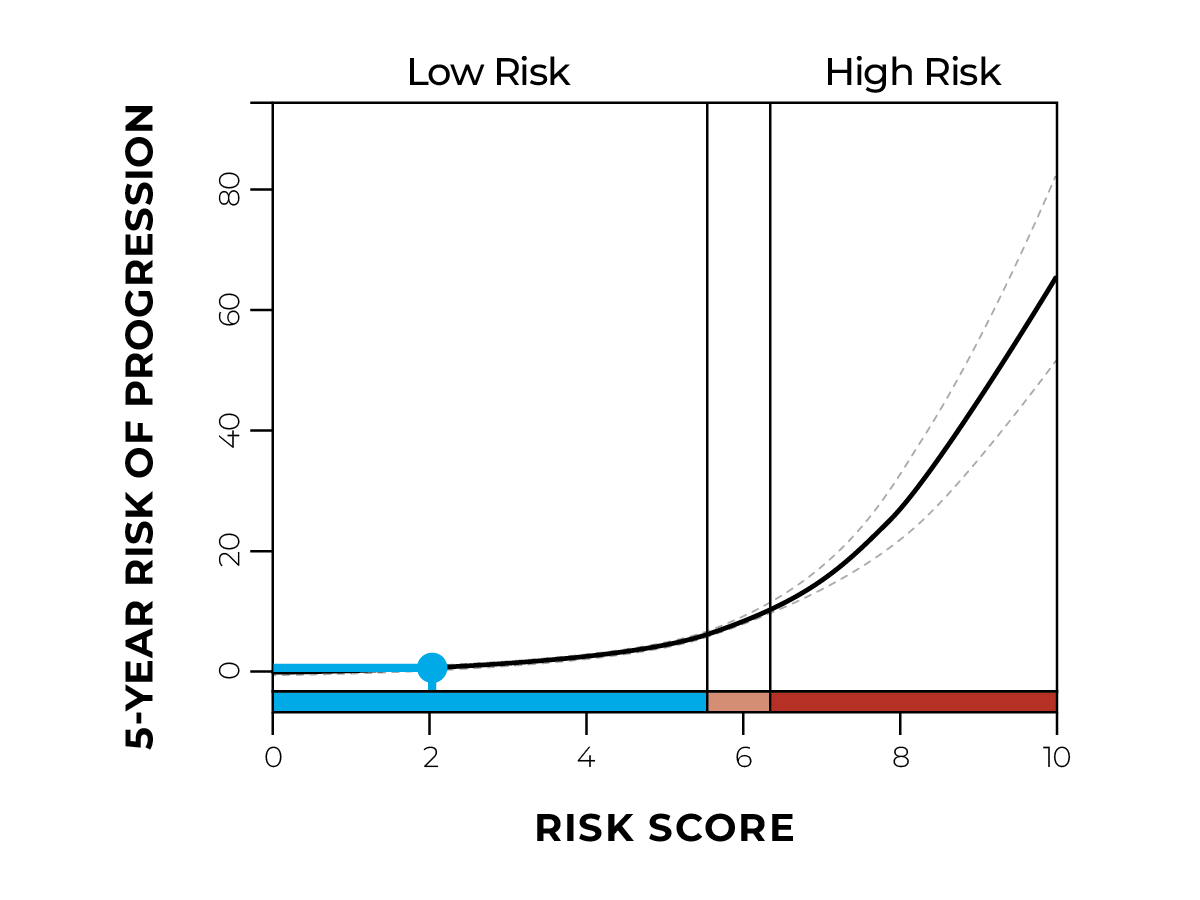
The patient was reassured upon receiving a TissueCypher low-risk score with a 5-year probability of progression of 0.8%. Because of the low risk of progression, Dr. Kotfila felt confident recommending surveillance instead of ablation.  

  • Risk class: Low
  • Risk score: 2.0
  • 5-year probability of progression: 0.8%

TissueCypher-guided management

  • Proceed with short-interval surveillance  

The power of TissueCypher is it helps you with information about the likelihood of what that tissue is going to look like five years down the road, and that is very helpful in directing your clinical decisions.”

Ronald Kotfila, MD