Case Study

This case involves a 49-year-old male patient with ultra-long-segment non-dysplastic Barrett’s esophagus (NDBE) who entered into long term surveillance after a low-risk TissueCypher score. Upon routine follow-up evaluation, changes to segment length were noticed, which prompted a new TissueCypher test and result.

“Now that he knows he’s at a much higher risk of progression, the patient has followed up again at the one-year interval.”

Case details

  • No relevant family history
  • Class 1 obesity
  •  Non-smoker
  • Chronic GERD for 26 years
  • On PPIs
  • Hiatal hernia repair and fundoplication

2017 endoscopic findings and TissueCypher-based management

  • Barrett’s segment length: C10M12
  • Indefinite for dysplasia at 2 sites
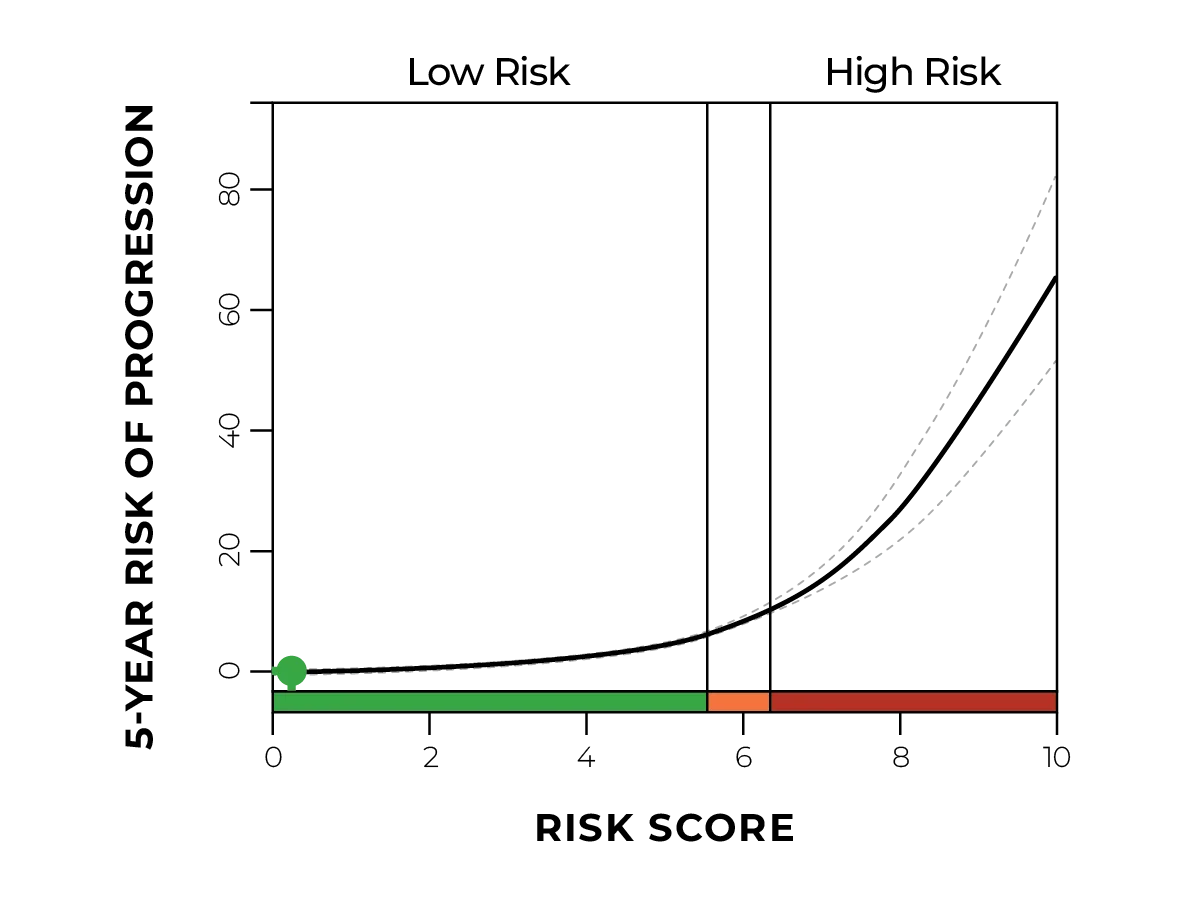
  • TissueCypher low-risk (score of 2.3)
  • After a repeat endoscopy and histologic findingof IND, the patient’s low-risk TissueCypher score informed a surveillance interval of 3 years.
  • Mild chronic inactive gastritis
  • Bravo pH shows recurrent reflux
Blue gradient background with vertical rounded lines in varying shades of blue scattered across the right side.
Dr. Khara: Case 2
Bearded man with glasses in blue blazer and shirt speaking in front of a blurred abstract painting.

A change in personal risk drives a change in compliance

This case involves a 49-year-old male patient with ultra-long-segment non-dysplastic Barrett’s esophagus (NDBE) who entered into long term surveillance after a low-risk TissueCypher score. Upon routine follow-up evaluation, changes to segment length were noticed, which prompted a new TissueCypher test and result.

“Now that he knows he’s at a much higher risk of progression, the patient has followed up again at the one-year interval.”

Clinical risk factors

A 49-year-old, white,male patient with a history of chronic GERD and ultra-long-segment, NDBE previouslyreceived a TissueCypher low-risk score.

RELEVANT MEDICAL HISTORY
  • No relevant family history
  • Class 1 obesity
  •  Non-smoker
  • Chronic GERD for 26 years
  • On PPIs
  • Hiatal hernia repair and fundoplication

2017 endoscopic findings and TissueCypher-based management

  • Barrett’s segment length: C10M12
  • Indefinite for dysplasia at 2 sites
  • TissueCypher low-risk (score of 2.3)
  • After a repeat endoscopy and histologic findingof IND, the patient’s low-risk TissueCypher score informed a surveillance interval of 3 years.
ADDITIONAL CONSIDERATIONS
  • Mild chronic inactive gastritis
  • Bravo pH shows recurrent reflux

Endoscopic Findings

The patient did not undergo surveillance at the recommended 3-year interval and instead returned after 5 years. Repeat endoscopy revealed an increase in Barrett’s segment length, while all 13 biopsies remained nondysplastic.

 Lower esophagus:

  • Barrett’s segment length: C13M13 5
  • 5cm recurrent hiatal hernia
  • Pathology returned NDBE

Traditional Management:

  • Treatment recommendation: 3-year surveillance

TissueCypher results

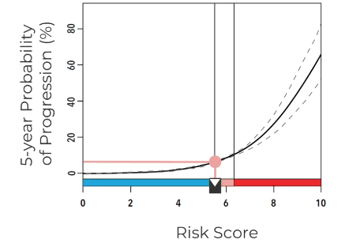
The patient’s TissueCypher risk score progressed from low-risk to intermediate-risk over a 5-year interval. Dr. Khara took this into consideration, along with the increased BE segment length, and ultimately recommended a shortened surveillance interval.  

  • Risk class: Intermediate‍
  • Risk score: 5.5‍
  • 5-year probability of progression: 5%

 TissueCypher-guided management

  • Shorten surveillance interval to 1 year

“This case highlighted that if there is a change in patient characteristics or the Barrett’s length, the [TissueCypher] risk score also needs to be rechecked.”

Harshit Khara, MD