Case Study

A 33-year-old caregiver brings her mother to Dr. Khara for treatment of intramucosal cancer. During the visit, she shares that she had been diagnosed with Barrett’s esophagus (BE) in the past. Dr. Khara urges her not to delay her own care and invites her to return for her own surveillance evaluation.

 See the case details below to learn how Dr. Khara helped this patient.

Case details

  • Family history of BE with intramucosal cancer (mother underwent endoscopic eradication therapy (EET))
  • Class 3 obesity
  • Smoker
  • Chronic GERD, on PPIs
  • History of long-segment NDBE
  • None
Blue gradient background with vertical rounded lines in varying shades of blue scattered across the right side.
Dr. Khara: Case 1

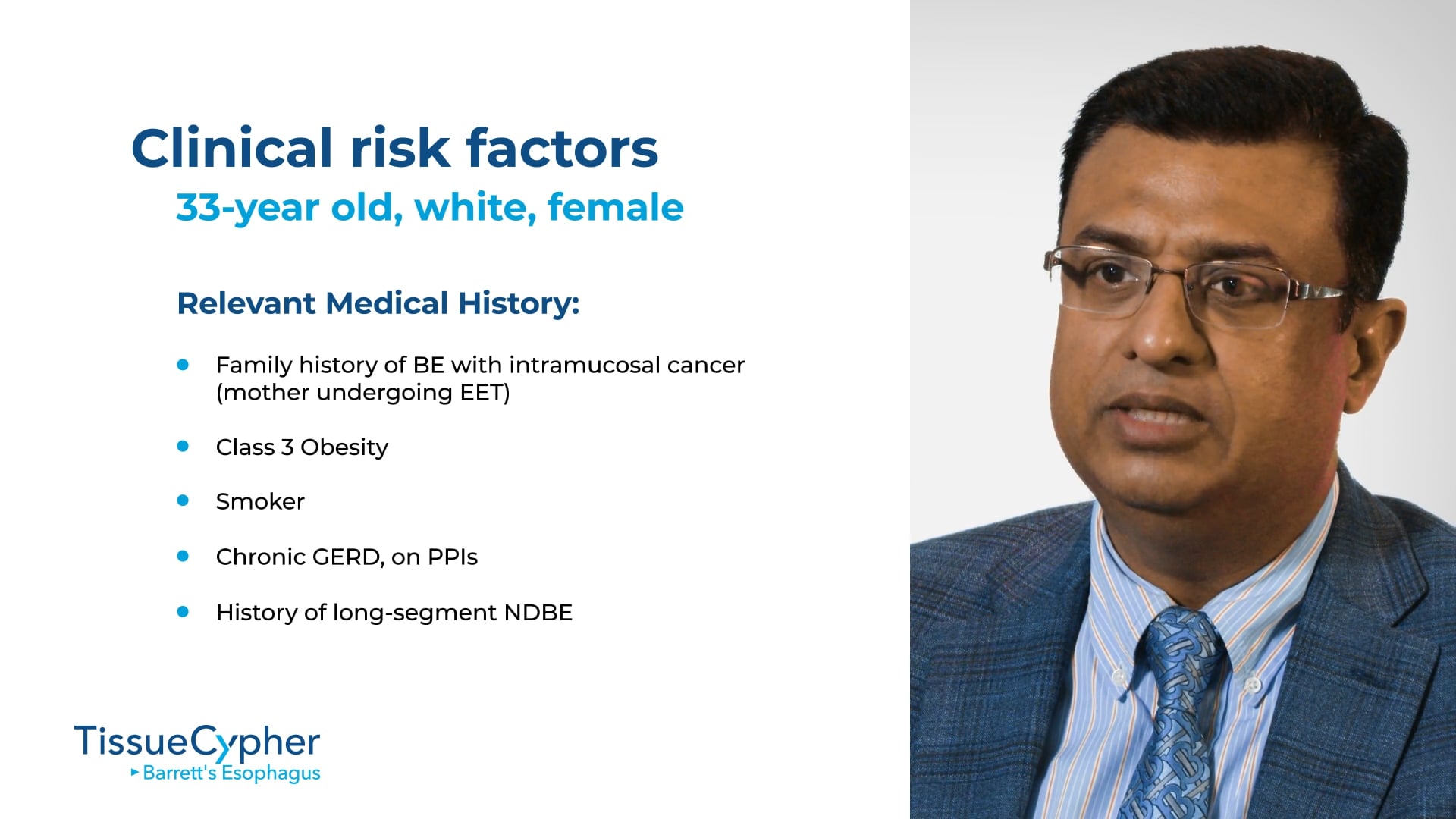
Clinical risk factors

A 33-year-old, white, female patient previously diagnosed with long-segment non-dysplastic Barrett’s esophagus (NDBE) sought follow-up evaluation of her condition. Given her mother’s history of esophageal cancer, the patient was motivated to pursue continued surveillance.

‍

RELEVANT MEDICAL HISTORY
  • Family history of BE with intramucosal cancer (mother underwent endoscopic eradication therapy (EET))
  • Class 3 obesity
  • Smoker
  • Chronic GERD, on PPIs
  • History of long-segment NDBE
ADDITIONAL CONSIDERATIONS
  • None

Endoscopic findings

The endoscopy confirmed the presence of long-segment, NDBE by traditional pathology.

 Lower esophagus:

  • Barrett’s segment length: C2M6
  • No evidence of nodularity
  • Pathology returned NDBE
  • WATS3D returned indefinite for dysplasia

Traditional Management:

  • Treatment recommendation: 6-month surveillance and PPI use

TissueCypher results

The patient’s TissueCypher results showed a high-risk classification with a 5-year probability of progression of 43%. Having accompanied her mother through esophageal cancer treatment, the patient expressed appreciation that her own disease was identified early, and Dr. Khara recommended EET to prevent likely progression.


  • Risk class: High 
  • Risk score: 8.9‍
  • 5-year probability of progression: 43%

TissueCypher-guided management

  • Escalated to EET

"To me, this is a lifesaver because she did not have to go through the morbidity of developing cancer or undergoing cancer treatment. We were able to treat her before she developed a high-risk disease state.”

Harshit Khara, MD