

Case Study

Philip Woodworth, MD, FACS, a foregut surgeon at the Institute for Esophageal and Reflux Surgery, consulted with a patient that was interested in a surgical solution to his long-standing acid reflux. A fundoplication surgery was scheduled, and it included an upper endoscopy that biopsied a 1 cm segment of non-dysplastic Barrett’s esophagus (NDBE).

It's standard practice for Dr.Woodworth to order TissueCypher on all NDBE cases, and in this case the results led to a significant change in management.

See the details below to learn how Dr. Woodworth navigated this surprising case.

Case details

  • Chronic GERD, long term PPI
  • Not especially obese 
  • No relevant family history
  • Non-smoker
  • Hiatal hernia
Case Study

Philip Woodworth, MD, FACS, a foregut surgeon at the Institute for Esophageal and Reflux Surgery, consulted with a patient that was interested in a surgical solution to his long-standing acid reflux. A fundoplication surgery was scheduled, and it included an upper endoscopy that biopsied a 1 cm segment of non-dysplastic Barrett’s esophagus (NDBE).

It's standard practice for Dr.Woodworth to order TissueCypher on all NDBE cases, and in this case the results led to a significant change in management.

See the details below to learn how Dr. Woodworth navigated this surprising case.

Case details

  • Chronic GERD, long term PPI
  • Not especially obese 
  • No relevant family history
  • Non-smoker
  • Hiatal hernia
Case Study

Philip Woodworth, MD, FACS, a foregut surgeon at the Institute for Esophageal and Reflux Surgery, consulted with a patient that was interested in a surgical solution to his long-standing acid reflux. A fundoplication surgery was scheduled, and it included an upper endoscopy that biopsied a 1 cm segment of non-dysplastic Barrett’s esophagus (NDBE).

It's standard practice for Dr.Woodworth to order TissueCypher on all NDBE cases, and in this case the results led to a significant change in management.

See the details below to learn how Dr. Woodworth navigated this surprising case.

Case details

  • Chronic GERD, long term PPI
  • Not especially obese 
  • No relevant family history
  • Non-smoker
  • Hiatal hernia
Blue gradient background with vertical rounded lines in varying shades of blue scattered across the right side.
Case Study
Bearded man with glasses in blue blazer and shirt speaking in front of a blurred abstract painting.

TissueCypher high-risk score leads to discovery of high-grade dysplasia

Philip Woodworth, MD, FACS, a foregut surgeon at the Institute for Esophageal and Reflux Surgery, consulted with a patient that was interested in a surgical solution to his long-standing acid reflux. A fundoplication surgery was scheduled, and it included an upper endoscopy that biopsied a 1 cm segment of non-dysplastic Barrett’s esophagus (NDBE).

It's standard practice for Dr.Woodworth to order TissueCypher on all NDBE cases, and in this case the results led to a significant change in management.

See the details below to learn how Dr. Woodworth navigated this surprising case.

Clinical risk factors

A 67-year-old white, male patient was referred to Dr. Woodworth for hiatal hernia repair after experiencing long-standing reflux. While he’s had endoscopies in the past, he didn’t present with any concerning risk factors.

RELEVANT MEDICAL HISTORY
  • Chronic GERD, long term PPI
  • Not especially obese 
  • No relevant family history
  • Non-smoker
ADDITIONAL CONSIDERATIONS
  • Hiatal hernia

Endoscopic findings

Upon completion of the fundoplication, Dr. Woodworth completed an upper endoscopy.

 Lower esophagus:

  • BE segment: C0M1
  • Pathology returned NDBE

Traditional Management:

  • Considered low risk per guidelines, given his short segment and non-dysplastic histology
  • Treatment recommendation: 3 - 5-year surveillance

TissueCypher results

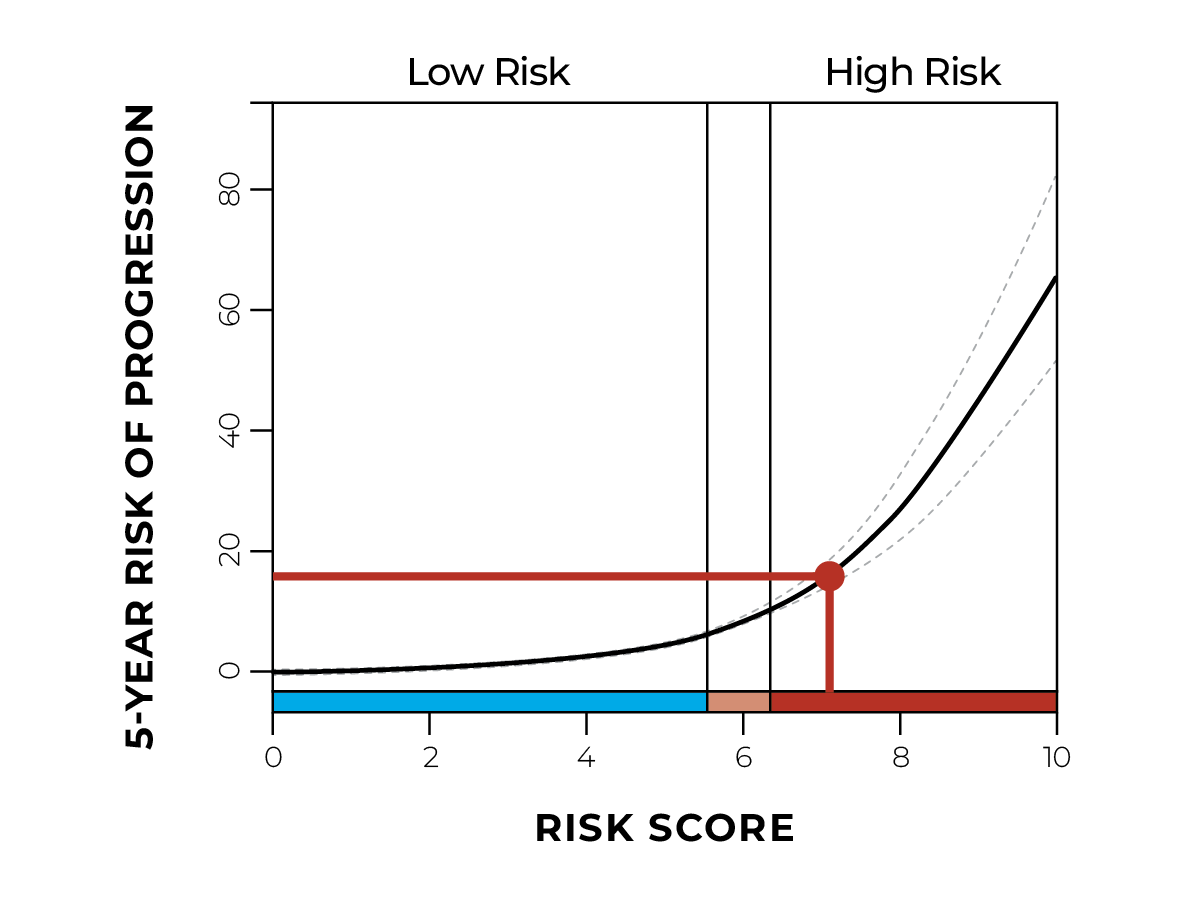
Dr. Woodworth was surprised by the patient’s high risk of progression, and he promptly adjusted the treatment plan and scheduled a 6-month follow-up. At that visit, the subsequent endoscopy revealed high-grade dysplasia (HGD) that was confirmed by pathology. Given that finding, the patient agreed to proceed with endoscopic eradication therapy to eradicate the disease and eliminate the risk of further progression.

  • Risk class: HIGH
  • Risk score: 7.1
  • 5-year risk of progression: 17%
TissueCypher-guided management
  • 6-month post-surgery follow-up with EGD, where HGD was discovered
  • Escalated to EET

What would have happened in the past is that we'd say, 'Ok, sir, you have non-dysplastic Barrett’s; it’s unlikely to progress to cancer. What we are going to do for you is we’re going to put you into this routine screening program, we’ll see you back in 3years…' Now we order TissueCypher on all our non-dysplastic Barrett’s patients."

Phillip Woodworth, MD